According to the Verizon 2025 Data Breach Investigations Report, the human element was a factor in 60% of data breaches. Employee cybersecurity training in Brea helps your team recognize threats, handle information safely, and report suspicious activity. Strong programs pair practical awareness lessons with phishing simulations that show how people respond in realistic situations.
You already know security tools matter. So do the everyday choices employees make when an unexpected email, message, or request arrives. The goal isn’t to make people wary of every click. It’s to build clear habits they can rely on under pressure.
Learn what effective awareness training covers, how to tailor it to your team, and what phishing simulation results can reveal about employee behavior. You’ll come away with a practical approach to making training an ongoing part of your security strategy, not a one-time event.
Key Takeaways
- Build awareness around the real decisions employees face, from suspicious messages to safe handling of sensitive information.
- Shape training around your team’s roles and risks, then reinforce it with short, practical learning moments.
- Use phishing simulations to spot behavior patterns and decide where follow-up coaching can make a difference.
- Connect employee awareness with broader security needs through managed IT services and cybersecurity support from Uptime Co.
What’s Employee Cybersecurity Awareness Training?
Employee cybersecurity awareness training teaches people to spot common attacks and respond safely. For Brea businesses, connect each lesson to real work, such as handling email attachments or accessing the company network.
Cover threats employees may encounter: phishing messages that imitate trusted sources, malware hidden in downloads, and ransomware that locks files. Fileless attacks use legitimate system tools, which can make suspicious behavior harder to spot. Social engineering pressures staff to reveal information or approve a request. DDoS attacks overwhelm online services, while identity-based attacks misuse stolen credentials. Use examples from email, websites, and workplace requests to practice pausing, verifying, and reporting.
Password Attacks and Credential Theft
Password attacks try to guess, reuse, or steal sign-in details. Credential theft lets attackers access an account, potentially exposing company files or helping them move across a network. Teach staff not to reuse passwords, to watch for unexpected login prompts, and to report suspicious credential-reset requests. Make the reporting route easy to find.
Training Requirements, Costs, and Providers
Training requirements, costs, and provider choices depend on your organization’s obligations, needs, and approach. Are there local or California requirements? The CCPA can impose civil penalties of up to $7,500 per intentional violation, according to the California Legislature. That penalty does not itself establish a universal training mandate. How much does training cost in Brea? Cost depends on the case and is given after a quote request; delivery format, audience, and program scope shape it. What providers serve Brea businesses? Options include internal security teams, training platforms, and managed cybersecurity providers. Choose lessons that match employees’ actual tools and responsibilities.
Planning and implementing employee cybersecurity awareness training
Build your plan around employees’ tasks and the risks they face. For employee cybersecurity training in Brea, start with the real decisions people make during a typical workday.
Organizational Best Practices
Make security awareness part of everyday work. The Small Business Administration identifies employees and work-related communications as a leading cause of data breaches for small businesses. Show staff how to verify unusual requests, report suspicious activity, and use the internet safely. For employee cybersecurity training in Brea, give your team a clear reporting contact and examples drawn from its actual workflows.
Training Programs, Tools, and Materials
Employees in Brea can learn through self-paced modules, instructor-led sessions, and scenario discussions. Small businesses can pair online lessons with short team conversations to fit busy schedules. Use sample messages, reporting checklists, and ransomware scenarios to make the material practical. CISA tabletop exercise resources can help teams discuss responses to different threat scenarios. Choose tools that let employees revisit key materials when questions come up.
Training Frequency and Certification
Short modules lasting 5-10 minutes, delivered monthly or after risk events, can keep key topics fresh. Refresh a lesson when a new scam reaches employees or a work process changes. A cybersecurity awareness certificate can document course completion, but pair it with exercises that show whether staff can apply what they learned.
Risks of Inadequate Training
Without practical training, employees may miss warning signs, delay reporting, or overlook security procedures. That can give an attacker more time to misuse an account or spread ransomware across a network. Make the reporting route easy to find, then practice it with realistic scenarios. For help aligning your plan with technical protections, explore cybersecurity solutions.
Phishing simulations and behavioral measurement
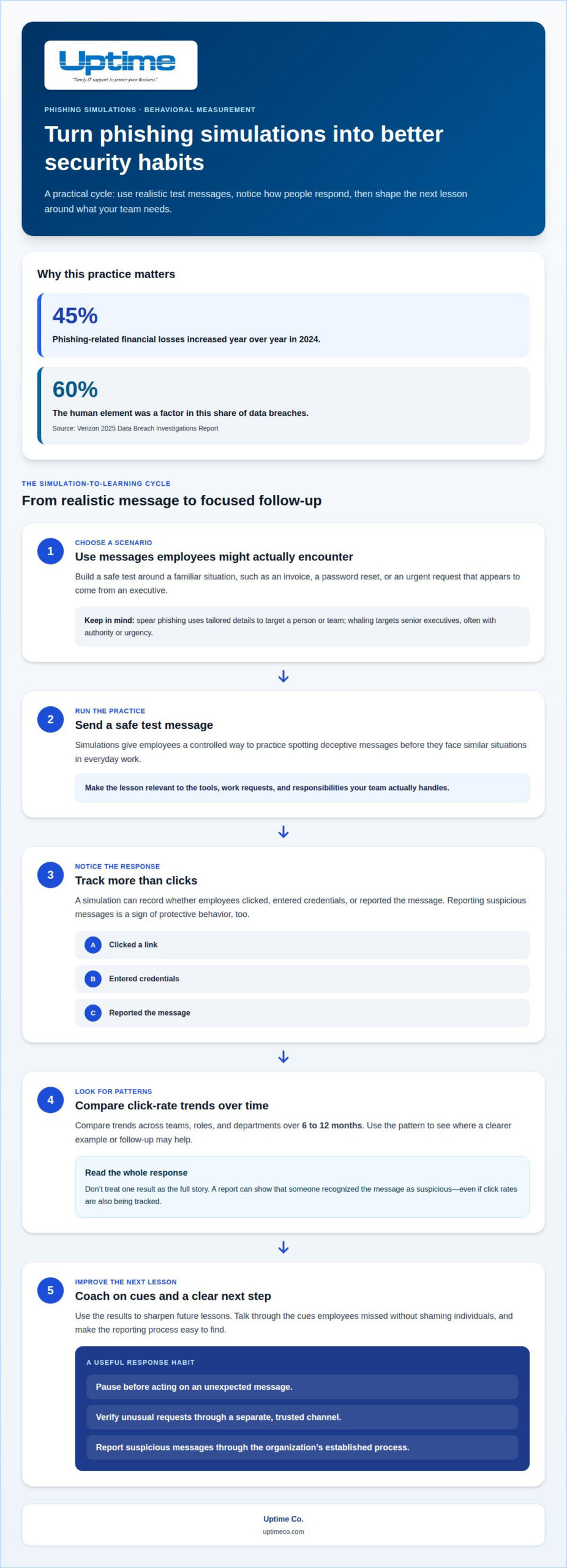
Simulations let employees practice spotting deceptive messages in a controlled setting. Track their actions and use the results to sharpen future lessons.
Phishing and Social Engineering
Phishing is social engineering delivered through messages designed to manipulate people into unsafe actions. Spear phishing targets a specific person or team with tailored details. Whaling targets senior executives, often using authority or urgency to prompt a quick response. These variations matter because a polished message can seem credible even when the sender’s identity is false.
Teach employees to pause before opening links, sharing credentials, or approving unexpected requests. An invoice, password reset, or urgent executive request can make a useful training example. Ask staff to verify unusual requests through a separate, trusted channel and report suspicious messages through the organization’s established process.
Phishing Simulations and Prevention
A phishing simulation sends a safe test message, then records actions such as clicks, credential entries, and reports. Compare click-rate trends across teams, roles, and departments over 6 to 12 months. The trend can help identify where security awareness training needs a clearer example or follow-up. Avoid treating a single result as the whole story; reporting suspicious messages also shows protective behavior.
Phishing-related financial losses increased by 45% year over year in 2024. The Verizon 2025 Data Breach Investigations Report found the human element was a factor in 60% of data breaches. Use those risks to prioritize realistic scenarios, then discuss the cues employees missed without shaming individuals. Strong prevention connects the lesson to a clear next step: report, verify, and pause before acting. To strengthen your broader defenses, explore phishing-focused cybersecurity support.
Uptime Co.: Managed IT Services
Uptime Co. helps connect employee awareness with the technical protections around your business. Its Cybersecurity Solutions include security awareness training, while Managed IT Services support organizations that want training to work alongside their security processes.
Turn to Uptime Co. when you’re aligning staff practices with your broader technology environment. Training can teach employees to report suspicious messages, while Network Infrastructure and Cloud Services support the systems they use to work and share information. This integrated approach considers both human behavior and the technology that protects business operations.
Ready to align employee training with your security priorities? Contact Uptime Co. to start the conversation.
Make Your Next Security Move Count
Make your training plan part of daily operations. Choose a practical next step: assign an owner, set a reporting path, or schedule a team discussion about a current threat. Then review what employees find confusing. Their feedback can help keep lessons relevant as workflows and risks change.
A thoughtful employee cybersecurity training plan in Brea can also connect staff awareness with the systems they use. Uptime Co. offers Managed IT Services, Cybersecurity Solutions, and Cloud Services to support that broader approach. If you’re ready to align employee training with your organization’s technology priorities, contact Uptime about employee training. Keep the next step simple, practical, and clear. Every useful habit your team builds strengthens the way it works. Start with one action and build from there.
Frequently Asked Questions
What Does the Cybersecurity Awareness Course Cover?
A cybersecurity awareness course should help employees make safer choices throughout the workday. Cover confidential documents, approved software, device security while traveling, and protecting information during remote work. For example, explain how to store a work file before taking a laptop offsite. Use your organization’s policies so the advice matches its actual tools and processes.
What Is the Difference Between Security Awareness and Security Training?
Security awareness helps employees understand why safe practices matter; security training teaches them how to carry out specific tasks. A lesson might explain why access should be limited to people who need it. Practical training can then show a manager how to remove a former employee’s access. Together, they connect the reason behind a policy to the action that supports it.
What topics should employee cybersecurity training cover, including phishing and ransomware?
Alongside phishing and ransomware, tailor the curriculum to the systems and information each role handles. Finance staff may need practice following internal payment-change procedures; customer-facing teams may need guidance on protecting personal information during calls. Include how to respond to multifactor authentication prompts and where to find approved data-handling rules. Role-based examples connect broad security topics to specific responsibilities.
How can Brea businesses compare in-person, online, and managed cybersecurity training?
Compare how each option handles course updates, employee onboarding, completion records, and role-specific content. In-person sessions suit teams that benefit from discussion; online material supports self-paced learning; managed training can reduce the internal work of organizing and maintaining a program. Uptime Co.’s Cybersecurity Solutions include security awareness training for businesses seeking training alongside cybersecurity support.
How do businesses measure employee cybersecurity training effectiveness?
Check whether employees can explain the policies that apply to their roles, not just whether they completed a course. Short knowledge checks can reveal unclear instructions, while manager reviews can show whether staff follow required steps in routine work. Use the findings to update examples, clarify procedures, and focus future lessons on what employees find hardest to apply.