A technology purchase can be technically sound and still move your business in the wrong direction. Technology alignment for Brea businesses means connecting IT decisions to shared business goals, with leaders agreeing on what success looks like. That keeps technology focused on the work your organization needs to do, not just the tools it can buy.
It’s easy to see why alignment matters: technology choices affect how people work, serve customers, and plan for growth. The key is bringing business and IT leaders together before making decisions. You’ll learn what business-IT alignment means, how shared objectives connect technology choices with business strategy, and what to look for in a roadmap that ties each initiative to a clear outcome. You’ll also see how a professional partner can turn priorities into practical technology decisions.
Key Takeaways
- Connect each technology investment to a business goal, then agree on how leaders will measure its value.
- Bring IT, finance, and business leaders into planning early so priorities and trade-offs are clear.
- Map the people and processes affected before choosing technology, and coordinate initiatives through a shared roadmap.
- When you need help putting priorities into practice, Uptime offers Managed IT Services, Cybersecurity Solutions, Cloud Services, and Network Infrastructure.
1. What is business-IT alignment?
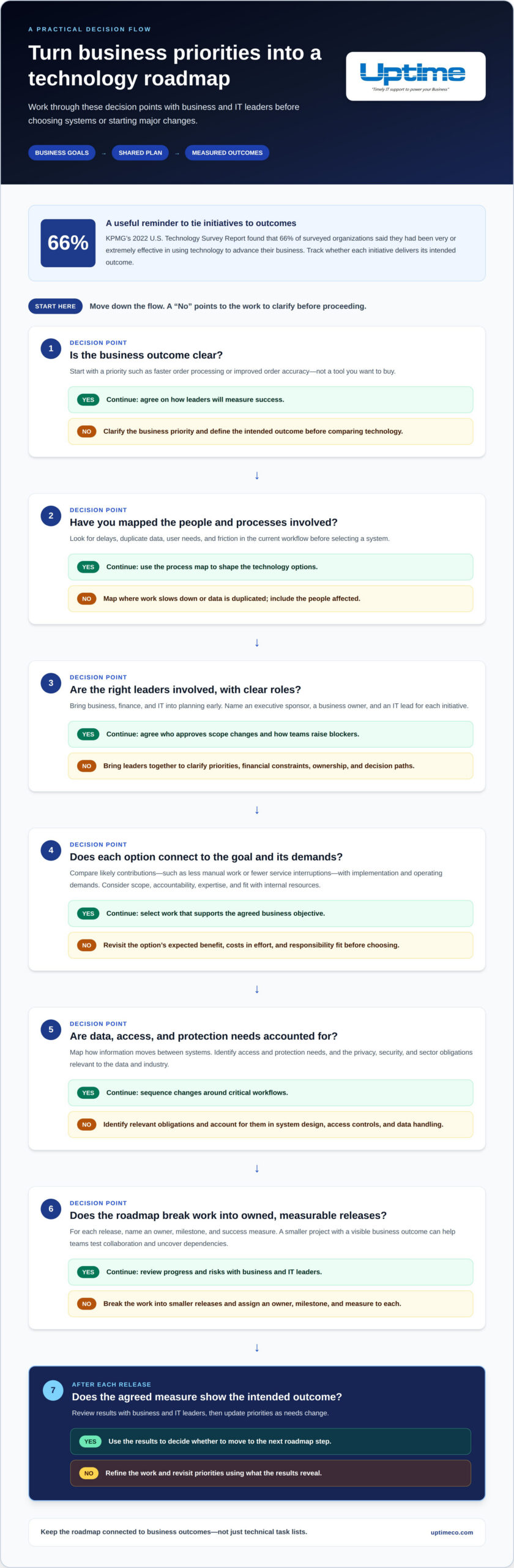
Business-IT alignment connects technology investments to business goals. Leaders set shared objectives, then turn each one into a practical initiative. For example, if a business wants to process orders faster, IT and operations can identify where delays occur before choosing a system. The aim is a business outcome, not simply a new tool.
Shared goals also guide investment decisions. A technology alignment provider can map proposed upgrades to business priorities, expected benefits, and success criteria. To assess return on investment (ROI), compare each option’s likely contribution, such as less manual work or fewer service interruptions, with its implementation and operating demands.
When comparing managed services with in-house IT, review each model’s scope, accountability, expertise, and fit with your internal resources. A managed IT provider should explain how its recommendations support business objectives; an in-house team may have close knowledge of daily workflows. Start by defining which responsibilities the business needs covered.
Assessment starts with business goals, user needs, and current processes. A provider can identify where technology supports those needs and where gaps create friction, then prioritize improvements against agreed outcomes. For a retailer, that could mean checking whether inventory systems support accurate, timely stock decisions.
Cloud, cybersecurity, and data systems should support the same priorities. A provider can map how information moves between systems, identify access and protection needs, and sequence changes around critical workflows. For voice and communications, specialists like Business Telecom demonstrate how cloud phone solutions can be structured directly around operational requirements. This keeps a cloud initiative connected to the business process it is meant to improve.
California and federal privacy requirements vary according to the data a business handles and its industry. Identify the relevant privacy, security, and sector obligations, then account for them in system design, access controls, and data-handling practices.
Misaligned technology can leave teams with disconnected data, duplicated work, weak access controls, or systems that interrupt essential operations. A provider’s risk review should connect each gap to a business process, so leaders can prioritize practical safeguards and improvements.
2. C-suite collaboration and shared objectives
For an organization, collaboration starts when executives agree on why a technology project matters. The CEO can define the business priority, the CFO can clarify financial constraints, and IT leadership can translate both into technology outcomes. For example, a goal to shorten customer response times needs an agreed measure and a clear owner before teams choose a solution.
Shared direction makes project decisions more useful. Business leaders explain customer needs and operational friction; IT leaders identify technical dependencies and delivery risks. When both groups shape the plan, they can surface trade-offs early, such as whether to improve an existing workflow or replace a system. Keep the decision tied to the intended outcome.
Set governance before work begins. Name an executive sponsor, a business owner, and an IT lead for each initiative. Agree on who approves scope changes, how teams raise blockers, and which shared measures show progress. Clear roles help prevent conflicting priorities from quietly expanding a project.
Regular reviews keep work connected to business needs. Schedule a weekly check-in between business advisory board members and IT to discuss project status. At each meeting, review completed work, emerging risks, and the next decision required. Keep the discussion focused on outcomes, not just technical task lists.
For a new customer platform, for instance, sales leadership might define the customer experience goal, finance might assess business value, and IT might plan integrations and safeguards. A focused IT governance review can help clarify roles, measures, and decision paths before major work begins. That foundation makes collaboration part of project delivery, not a meeting added after problems appear.
3. Aligning technology and business strategies
Strategy becomes useful when it guides which technology work happens first. Start with a business priority, such as improving order accuracy, then identify the people and processes involved. Map delays or duplicate data before selecting a system. This sequence grounds innovation in a real operational need.
KPMG’s 2022 U.S. Technology Survey Report found a gap worth examining. 66% of surveyed organizations said they had been very or extremely effective in using technology to advance their business. For leaders, the practical takeaway is to connect each initiative to an outcome and track whether it delivers.
Build a shared roadmap that connects business changes with IT work. For example, a manufacturer aiming to reduce equipment downtime might first improve maintenance data, then assess tools that support predictive maintenance. Break a large project into smaller releases, each with a clear owner, milestone, and success measure. Teams can learn from early results and adjust the next step.
Keep the roadmap adaptable. Use a manageable project with a visible business outcome to test collaboration and uncover dependencies. Track agreed measures, such as order accuracy or time spent on manual processing, when they fit the goal. Review results with business and IT leaders, then update priorities as needs change. For technology alignment for Brea businesses, this turns strategy into a working plan, not a one-time document.
Ready to connect your roadmap to business goals? Plan a technology strategy review around the outcomes your team needs.
As the roadmap moves forward, start by checking whether the maintenance data is reliable and who will keep it up to date. Before each release, confirm its owner, milestone, and success measure with both business and IT teams. After launch, use the agreed measure to decide whether to refine the work or move to the next step.
Uptime
Uptime Co. helps Brea businesses connect technology decisions with operational priorities. Turn to its team when systems, security, and growth plans need a clearer shared direction. The work can start with your goals, processes, and existing technology, then identify where Managed IT Services, Cybersecurity Solutions, Cloud Services, or Network Infrastructure can help.
Bring your business priorities, known technology challenges, and upcoming initiatives to the conversation. This context helps shape recommendations around the outcomes your organization values, not technology for its own sake. Uptime Co. can help assess next steps and build a more coordinated approach to IT planning.
Contact Uptime Co. to discuss how your technology can better support your business goals.
Make your next technology decision count
Technology alignment for Brea businesses becomes a lasting advantage when leaders revisit priorities as customer needs, workflows, and growth plans evolve. Treat the roadmap as a living decision tool. Each proposal should show which business outcome it supports, who will use it, and how the team will measure progress. This habit keeps future investment focused while leaving room for useful innovation. Before approving another tool, ask how it will change a specific decision or task.
Uptime Co. supports this work through Managed IT Services, Cybersecurity Solutions, and Cloud Services, connecting technology planning to practical business needs. Bring your current priorities and the challenges slowing your team down. A focused discussion can clarify where to begin and what deserves attention next.
Contact Uptime Co. to discuss alignment, and take the next step with confidence.
Frequently Asked Questions
What is business-IT alignment?
Business-IT alignment means making technology decisions that support how an organization needs to operate and grow. For example, before adopting a customer platform, teams can map how staff handle inquiries and identify where information gets delayed. This shapes requirements around actual work, rather than selecting features first and expecting employees to adapt.
What technology alignment consultants and IT service providers serve Brea, California?
Uptime Co. serves businesses in Brea, California, and provides IT Consulting & vCIO alongside ongoing technology services. Bring a planned system change, workflow challenge, or growth priority to frame a useful discussion. The right support connects business needs to practical IT planning, rather than treating each technology decision as a standalone purchase.
Which technology upgrades offer the best ROI for Brea businesses?
The strongest ROI comes from upgrades tied to agreed business goals, such as reducing manual work or service interruptions. Compare each option’s expected contribution with its implementation and operating demands.