The best IT decision for your Brea business may not be another quick fix. The benefits of a vCIO for Brea SMBs come from strategic technology guidance: assessing risk, addressing compliance needs, and aligning IT plans with business goals. Day-to-day support keeps systems running; a dedicated vCIO team helps decide where technology should go next.
When you’re balancing security concerns, growth plans, and technology decisions, it can be hard to know what deserves attention first. A dedicated vCIO team brings strategic perspective without adding a full-time executive role. It can help with risk planning and compliance, turn business priorities into an IT roadmap, and distinguish long-term planning from daily troubleshooting, so you can choose the support that fits your next move.
Key Takeaways
- Use ongoing risk reviews to surface vulnerabilities and shape security priorities around your business’s compliance needs.
- Connect technology investments to business goals with a roadmap that clarifies priorities, timing, and budget decisions.
- Separate strategic guidance from daily IT support so you know which decisions need planning and which need operational attention.
- Consider vCIO consulting when growth, security concerns, or major technology changes call for a clearer plan.
Risk assessment and regulatory compliance
If you run a California business, a vCIO can help you address privacy and cybersecurity requirements by mapping sensitive data, reviewing safeguards, and prioritizing gaps. An assessment can look at who accesses customer records, where information is stored, how backups work, and what to do after a security incident. You can use the findings to shape policies and prioritize practical improvements.
The right frameworks depend on your business and the data you handle. For healthcare data practices, HIPAA is a relevant framework, according to the U.S. Department of Health and Human Services. If you handle payment card data, you may need to consider PCI-DSS. For international operations, GDPR is a privacy safeguard, according to the European Union. A vCIO can help you identify relevant frameworks and develop policies, access controls, and staff guidance around them.
Good risk planning connects cybersecurity to your business goals instead of stopping at a checklist. A vCIO can assess vulnerabilities across devices, cloud systems, vendors, and employee practices, then rank threats by their potential effect on operations and sensitive information. For example, if a vendor can access customer records, the review can document that access and identify safeguards to strengthen security. In specialized sectors like financial services, firms often look to dedicated risk and regulatory consultants such as versapien.com to help align operations with strict industry standards.
Backups are part of the same risk picture. A vCIO can review backup coverage, recovery procedures, and ownership of response tasks, then add improvements to your IT roadmap. Practical steps include documenting who approves access, recording how incidents are escalated, and scheduling reviews when systems or data use change. This gives you a clearer view of risk, compliance priorities, and the decisions ahead.
Strategic IT roadmaps aligned with business goals
A vCIO turns business priorities into strategic technology decisions. The process starts with an assessment of current systems, workflows, and infrastructure. From there, the dedicated vCIO team connects proposed investments to goals such as supporting growth, improving collaboration, or preparing for a new location. For small and midsize businesses, this creates a clearer link between leadership’s plans and IT’s work.
A useful roadmap makes trade-offs visible. It can organize projects across four quarters and show timing, dependencies, budget needs, and decision owners. For example, if hiring will increase demand on shared systems, plan capacity upgrades before staff expansion. That way, technology spending supports the business plan instead of reacting to bottlenecks after they appear.
Scalable infrastructure matters as needs change. Reviewing existing systems, cloud services, and network capacity against expected growth helps identify practical, staged upgrades. This gives leadership a basis for deciding what to maintain, replace, or expand. Strategic IT guidance can also help evaluate technology partner proposals against business priorities, rather than treating each purchase as an isolated choice.
Continuity belongs on the roadmap too. Business continuity and disaster recovery strategies should account for system monitoring and data backups. Clarify which systems matter most, who owns recovery decisions, and how technology teams will coordinate during an outage. If you’re mapping growth or a major system change, IT roadmap planning can help connect those decisions to your business goals.
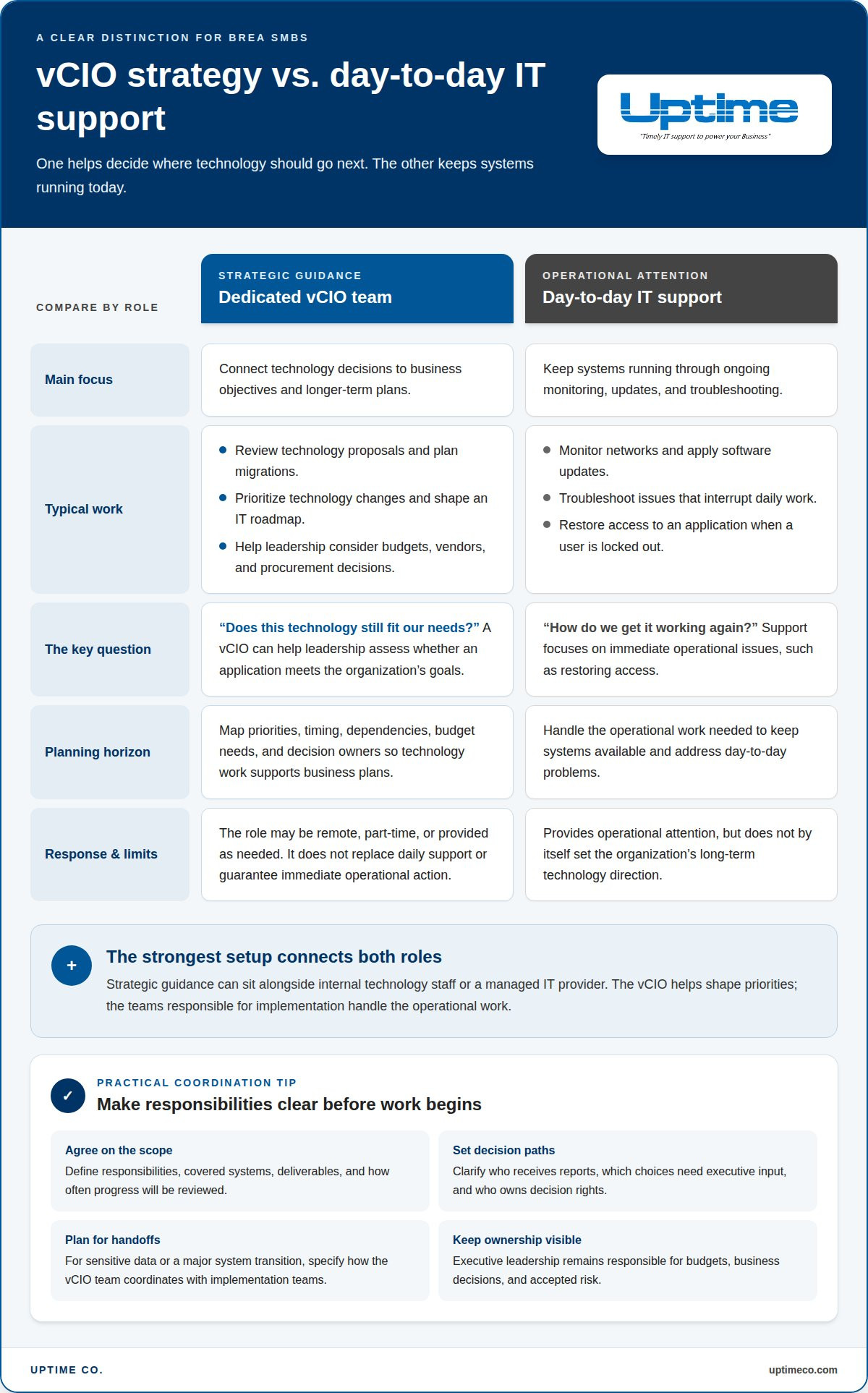
VCIO consulting compared with day-to-day IT support
Day-to-day IT support helps keep systems running with network monitoring, software updates, and troubleshooting. A dedicated vCIO team takes a more strategic view, helping connect technology decisions to business objectives. Support staff might restore access to an application; a vCIO can help leadership decide whether that application still meets the organization’s needs.
This difference matters when you need proactive oversight as well as incident response. vCIO services can help leaders review proposals, plan a migration, and prioritize technology changes. For Brea SMBs, a vCIO can provide strategic guidance alongside internal technology staff or a managed IT provider. To avoid confusion, define responsibilities, reporting, decision rights, and covered systems in the agreed scope.
Before hiring a vCIO, consider the role’s limits. The work may be remote and part-time or provided as needed, so it won’t replace daily support or guarantee immediate operational action. Be clear about deliverables and how often you’ll review progress. Executive leadership remains responsible for budgets, business decisions, and accepted risk.
Keep the partnership practical: identify which decisions need executive input, who receives reports, and how priorities may shift as business needs change. If sensitive data or a major system transition is involved, specify how the dedicated vCIO team will coordinate with the teams responsible for implementation. This helps connect strategic oversight with operational work.
Need clearer decision support beyond daily troubleshooting? Discuss strategic IT consulting to define the guidance your organization needs.
A vCIO focuses on long-term IT strategy, while an IT manager handles daily operations and support. A vCIO can also help businesses plan IT budgets, manage technology vendors, and make informed procurement decisions.
Uptime: IT Consulting & vCIO
Uptime helps Brea businesses make sense of technology concerns and decide what to tackle first. Whether you’re weighing security risks, planning for growth, or facing a major technology change, you can get guidance that connects those decisions to your business needs. When it makes sense for your goals, Uptime can also tie that planning to Managed IT Services, Cybersecurity Solutions, or Cloud Services.
Before you talk, jot down your key questions, current challenges, and upcoming business priorities. That gives the conversation a practical starting point and helps focus on the decisions that matter most. Get in touch with Uptime to talk about IT Consulting & vCIO for your business.
Make your next IT decision count
The benefits of a vCIO for Brea SMBs become tangible when planning leads to a decision leadership can own. Choose an upcoming priority, such as a system change, security improvement, or growth initiative. Use it to start a focused conversation about what matters now, what can wait, and who needs to be involved.
Uptime offers Managed IT Services, Cybersecurity Solutions, and Cloud Services to support the technology priorities that fit your business. A clear starting point can shape the discussion and keep next steps connected to your goals.
Talk with Uptime about vCIO support and bring one upcoming IT priority to the conversation. That can help you decide what kind of strategic guidance would be useful for your organization.
Frequently Asked Questions
What Is a vCIO?
A vCIO is an external technology advisor who offers executive-level guidance remotely, part-time, or as needed. Working with an executive technology firm such as TechAxis Advisors allows leadership to align technology, cybersecurity, and operational execution with overall business strategy. Unlike a full-time chief information officer, a vCIO gives an SMB strategic input without the cost of adding a full-time executive position. Business leaders still make the final calls on budgets, priorities, and the risks they’re willing to accept.
What Services Do vCIOs Provide?
A vCIO team can assess your technology needs, set priorities, plan budgets, and advise on security and compliance. It can also help you weigh major decisions, such as moving business applications to the cloud or replacing a core system. Before work begins, clarify which systems are covered and what reports or planning deliverables leadership expects.
What are the benefits of Virtual CIO services for growing companies?
Virtual CIO services help growing companies connect technology decisions to their next stage of business. If your Orange County firm is opening another location, an advisor can help you plan for connectivity, access, and coordination before teams start working across sites. Bring those dependencies into the conversation early so leaders can decide which changes to tackle first.
What does a vCIO do for a small or midsize business?
A vCIO helps small and midsize businesses think strategically about technology. If employees use separate tools to manage customer work, for example, the advisor can help leadership decide whether simplifying those systems supports business goals. The vCIO offers guidance, but internal leaders remain responsible for commitments and final decisions.
What are the main benefits of a vCIO for SMBs?
A vCIO can make decisions clearer, provide access to senior technology guidance, and help align IT priorities with business needs. If your SMB is preparing to replace a core application, an advisor can help you weigh staff needs, timing, and operational impact. Use those factors to give leadership a clearer basis for choosing a direction.