A project can look organized on paper and still lose momentum when priorities, budgets, and people pull in different directions. Brea IT project management brings these moving parts into a coordinated plan with clear ownership, communication, and change control.
An IT project needs more than a deadline and a task list. It needs leadership that connects business goals with technical work, keeps stakeholders aligned, and responds thoughtfully when requirements change. This article explains what project management can coordinate, how planning and budgeting shape delivery, and what to look for in a provider. You’ll get a practical view of the process, from setting priorities and managing dependencies to making decisions visible as the project progresses. Use it to understand how focused oversight can reduce confusion and keep your next IT initiative aligned with your organization’s needs.
Key Takeaways
- See how a clear project plan connects priorities, schedules, and budget decisions.
- Learn how project leadership can align stakeholders around decisions and responsibilities.
- Understand how steady communication and a clear change process keep work moving when needs shift.
- Explore how Uptime Co.’s IT services can support the technology behind your project.
Project planning, scheduling, and budgeting
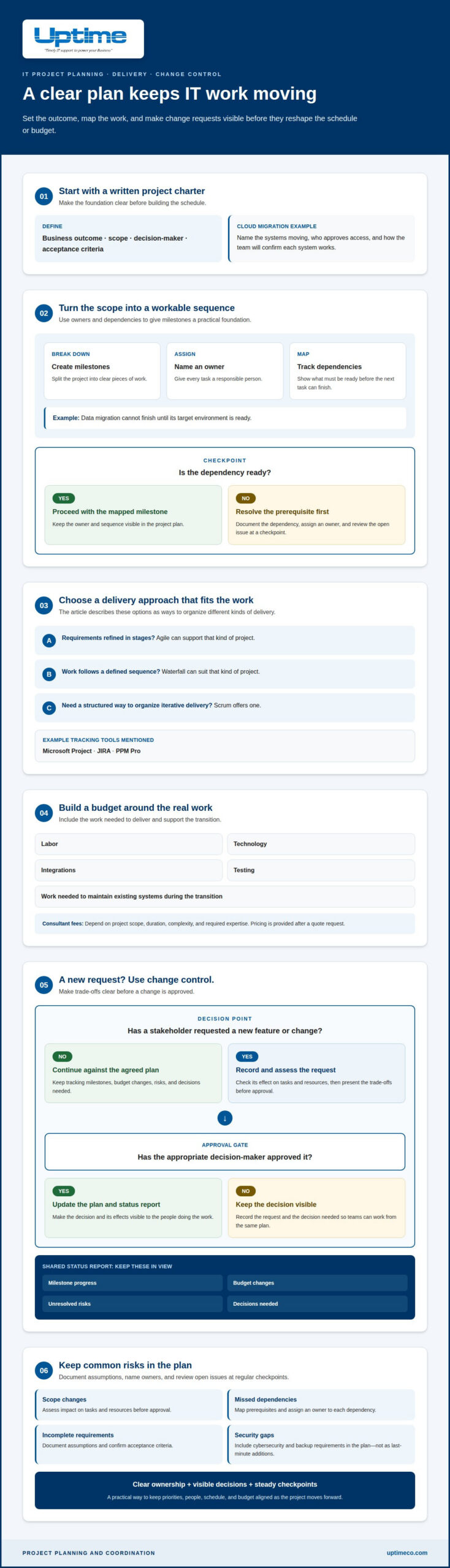
Start with a written project charter that states the business outcome, scope, decision-maker, and acceptance criteria. For example, a cloud migration plan should identify which systems will move, who approves access, and how the team will confirm each system works. Then break the work into milestones, assign an owner to each task, and map dependencies. Data migration cannot finish until its target environment is ready. This sequence gives the schedule a practical foundation instead of relying on optimistic dates.
Choose a delivery method that fits the work. Agile can support projects where teams refine requirements in stages; Waterfall can suit work with a defined sequence. Scrum offers a structured way to organize iterative delivery. Tools such as Microsoft Project, JIRA, or PPM Pro can help teams track tasks and dependencies. Consultant fees depend on project scope, duration, complexity, and required expertise; pricing is provided after a quote request. Build the budget around labor, technology, integrations, testing, and any work needed to maintain existing systems during the transition.
Common risks include scope changes, missed dependencies, incomplete requirements, and security gaps. A project connecting a new cloud platform to an existing network, for example, can stall if access or compatibility needs emerge late. Mitigate these risks by documenting assumptions, assigning an owner to each dependency, and reviewing open issues at regular checkpoints. Include cybersecurity and backup requirements in the plan, not as last-minute additions.
Effective Brea IT project management also uses change control to protect the schedule and budget. When a stakeholder requests a new feature, the project lead records it, assesses its effect on tasks and resources, and presents the trade-offs before approval. A shared status report can show milestone progress, budget changes, unresolved risks, and decisions needed. This gives leaders a clear view of what is on track and where action is needed.
Leadership and stakeholder management
A project lead turns competing priorities into decisions the team can act on. For a finance-system upgrade, the CFO may focus on reporting while IT prioritizes integrations and security. The lead brings these needs together, confirms the project’s business goal, and assigns decision-making authority. That keeps routine technical questions from waiting on executives and leaves major trade-offs with the right sponsor.
Start stakeholder management with a simple register. Record each person’s role, interest, influence, and preferred way to receive updates. Include the executive sponsor, project owner, IT staff, department leads, and employees affected by the change. Then map who contributes requirements, approves decisions, tests the solution, or needs advance notice. To support this collaboration, idea management software like Ideawake can help organizations capture and evaluate employee feedback early in the process. A department lead, for example, can flag a busy reporting period that could affect rollout timing.
Strong leadership also makes decisions visible. The project lead can maintain a decision log recording the issue, options, owner, and outcome. If teams disagree about a feature, the log captures its business impact and who has authority to choose. Set an escalation path for unresolved blockers, such as moving a scope decision from the project team to the sponsor. Clear ownership prevents repeated debates and informal approvals.
Keep stakeholders involved through targeted check-ins. A technical team may need detailed discussions about integrations, while executives need concise updates on outcomes, risks, and decisions. Ask department representatives to validate workflows before launch, then bring their feedback to the project team. For a coordinated approach to technology decisions, explore structured IT project support from Uptime Co..
Project communications and change management
Set a communication plan before work begins. Specify who receives status updates, which decisions need approval, and where the project team records changes. For a cloud migration, employees may need clear notice about workflow changes, while IT staff need technical release details. Tailor each update to its audience, and keep decisions in a shared project record.
Change management gives every request a consistent path. The project lead records it, checks its effect on users and connected systems, and routes it to the appropriate decision-maker. For example, adding a report to a CRM rollout may affect testing and staff training. Communicate the decision, revised expectations, and next steps so teams aren’t working from different versions of the plan.
Providers vary in the project work they include, such as planning, technical coordination, communications, and post-launch support. Compare the services offered with reviews that describe relevant project experience and clear communication. When choosing a consultant, look for a documented process, defined responsibilities, and experience with the systems involved in your project.
A Brea project manager job listing describes the PMI Project Management Professional certification as highly preferred. It is not a universal requirement for every project; relevant experience and the project’s delivery approach also matter.
Local demand spans industries. IT projects can matter to Brea businesses and public organizations, including schools and municipalities, when technology changes affect core operations. Clarify how a change affects staff, customers, and service delivery before setting communication priorities.
Bring your project’s communication and change needs into a focused planning conversation. Plan your IT project with Uptime Co.
Uptime
Uptime Co. helps connect an IT project’s goals with the systems that support your organization. Turn to Uptime Co. when a project touches several technology areas, such as cloud services, network infrastructure, cybersecurity, or ongoing IT operations. A coordinated view helps decision-makers understand how each workstream supports the broader business need.
Bring the project’s desired outcome, key concerns, and current technology context to the conversation. Uptime Co. can discuss how its Managed IT Services and other relevant offerings fit the work, including where security, cloud, and network needs intersect. This is a practical next step when your team needs experienced guidance to make technology decisions and keep the project aligned with operational priorities.
Contact Uptime Co. to discuss your IT project.
Set Your Next IT Project in Motion
Your next technology initiative is an opportunity to make work simpler, more secure, or easier to scale. Before it starts, define the business outcome you want and the decisions your team needs to make. That gives project planning clear direction from the outset.
Choose Brea IT project management that keeps technical work connected to your organization’s priorities. A focused conversation with Uptime Co. can clarify where coordination is needed, which teams should be involved, and what a useful next step looks like for your project.
Contact Uptime Co. about IT project management to talk through your goals and explore a practical path forward. Take the next step with confidence, and give your team a stronger foundation for what comes next.
Frequently Asked Questions
What IT project management services are available in Brea, California?
In Brea, businesses can get project support connected to managed IT, cybersecurity, cloud services, and network infrastructure. Uptime Co. serves organizations in Brea and Orange County. For example, a business planning a cloud migration can coordinate that work with its network and security needs, rather than treating each technology area as an isolated decision.
Which IT project management firms serve businesses in Brea, CA?
Uptime Co. serves businesses in Brea, California, and provides technology consulting alongside its managed IT offerings. Its services are relevant when a project affects daily IT operations, cybersecurity, cloud systems, or network infrastructure. Consider how closely a provider’s capabilities fit your project’s technical scope and operational needs, rather than relying on a firm name alone.
What steps do Brea IT project management providers follow, and what should a business supply?
Providers typically clarify the business goal, assess the technology involved, identify affected teams, and shape an implementation approach. To make the process productive, provide a plain-language description of the desired outcome, relevant system information, known constraints, and the names of people who can explain workflows or approve decisions. For example, note which teams depend on a system being replaced.
What local industries in Brea commonly need IT project management?
Local demand spans industries. Brea businesses and public organizations, including schools and municipalities, may need IT project management when technology changes affect core operations.